Biblical Canons
The Quinisext Œcumenical Council held in Trullo receives certain canons in other Councils & Fathers which enumerated the books of Sacred Scripture.
Besides those always received as the New Testament, these canons rather explicitly list for the Old Testament those books found in the Septuagint, & at any rate those also named in the Masoretic are deficient from the Septuagint versions used by the Councils & Fathers.
It should be known the Apocalypse was generally not counted as Scripture—and still now is never read in the Church—until St. Andrew of Crete gave an interpretation of it.
Quinisext Œcumenical Council
| 6201 AM. |
| Canon II: |
It has also seemed good to this holy council, that the eighty-five canons, received & ratified by the Holy & Blessed Fathers before us, & also handed down to us in the name of the Holy & Glorious Apostles, should from this time forth remain firm & unshaken for the cure of souls & the healing of disorders. And in these canons we are bidden to receive the Constitutions of the Holy Apostles by Clement. But formerly through the agency of those who erred from the faith certain adulterous matter was introduced, clean contrary to piety, for the polluting of the Church, which obscures the elegance & beauty of the divine decrees in their present form. We therefore reject these Constitutions so as the better to make sure of the edification & security of the most Christian flock; by no means admitting the offspring of heretical error, & cleaving to the pure & perfect doctrine of the Apostles.
But we set our seal likewise upon all the other holy canons set forth by our Holy & Blessed Fathers, that is, by the three hundred & eighteen Holy God-bearing Fathers assembled at Nicæa, & those at Ancyra, further those at Neocæsarea & likewise those at Gangra, & besides, those at Antioch in Syria: those too at Laodicea in Phrygia: & likewisenthe one hundred & fifty who assembled in this heaven-protected royal city: & the two hundred who assembled the first time in the metropolis of the Ephesians, &bthe six hundred & thirty Holy & Blessed Fathers at Chalcedon.
In like manner those of Sardica, &nthose of Carthage: those also who again assembled in this heaven-protected royal city under its bishop Nectarius & Theophilus Archbishop of Alexandria.
Likewise too the Canons [i.e. the decretal letters] of Dionysius, formerly Archbishop of the great city of Alexandria; & of Peter, Archbishop of Alexandria & Martyr; of Gregory the Wonder-worker, Bishop of Neocæsarea; of Athanasius, Archbishop of Alexandria; of Basil, Archbishop of Cæsarea in Cappadocia;℅of Gregory, Bishop of Nyssa; of Gregory the Theologian; of Amphilochius of Iconium: of Timothy, Archbishop of Alexandria; of Theophilus, Archbishop of the same great city of Alexandria; of Cyril, Archbishop of the same Alexandria; of Gennadius, Patriarch of this heaven-protected royal city.
Moreover the canon set forth by Cyprian, Archbishop of the country of the Africans & Martyr, & by the synod under him, which has been kept only in the country of the aforesaid bishops, according to the custom delivered down to them.
Council of Laodicea
| 5852 AM. |
| Canon LX: |
These are all the books of Old Testament appointed to be read: j. Genesis of the world; ij. the Exodus from Ægypt; iij. Leviticus; iv. Numbers; v. Deuteronomy; vi. Josue, the son of Nave; vij. Judges, Ruth; viij. Esther; ix. of the Kings, First & Second; x. of the Kings, Third & Fourth; xj. Chronicles, First & Second; xij. Esdras, First & Second; xiij. the Book of Psalms; xiv. the Proverbs of Solomon; xv. Ecclesiastes; xvi. the Song of Songs; xvij. Job; xviij. the Twelve Prophets; xix. Esaias; xx. Jeremias, & Baruch, the Lamentations, & the Epistle; xxi. Ezechiel; xxij. Daniel.
And these are the books of the New Testament: Four Gospels, according to Matthew, Mark, Luke & John; the Acts of the Apostles; Seven Catholic Epistles, to wit, j. of James, ij. of Peter, iij. of John, j. of Jude; xiv. epistles of Paul, j. to the Romans, ij. to the Corinthians, j. to the Galatians, j. to the Ephesians, j. to the Philippians, j. to the Colossians, ij. to the Thessalonians, j. to the Hebrews, ij. to Timothy, j. to Titus, & j. to Philemon.
Council of Carthage
| 5906 AM. |
| Canon XXVII: |
That besides the canonical Scriptures nothing be read in Church under the name of divine Scripture. But the canonical Scriptures are as follows: Genesis, Exodus, Leviticus, Numbers, Deuteronomy, Josue the son of Nave, the Judges, Ruth, the Kings, iv. books, the Chronicles, ij. books, Job, the Psalter, the v. books of Solomon [i.e. Proverbs, Ecclesiastes, Song of Songs, Wisdom, & Psalms], the twelve books of the Prophets, Esaias, Jeremias, Ezechiel, Daniel, Tobit, Judith, Esther, Esdras, ij. books, Maccabees, ij. books, the Gospels, iv. books, the Acts of the Apostles, j. book, the Epistles of Paul, xiv., the Epistles of Peter, the Apostle, ij., the Epistles of John the Apostle, iij., the Epistles of James the Apostle, j., the Epistle of Jude the Apostle, j.
Let this be sent to our brother & fellow bishop, Boniface, & to the other bishops of those parts, that they may confirm this canon, for these are the things which we have received from our fathers to be read in Church.
The Apocalypse was added at a subsequent council in 5928 AM.
St. Athanasius the Great
| †5882 AM |
As the heretics are quoting apocryphal writings, an evil which was rife even as early as when St. Luke wrote his gospel, therefore I have thought good to set forth clearly what books have been received by us through tradition as belonging to the canon, & which we believe to be divine.
For there are in all twenty-two books of the Old Testament. Genesis, Exodus, Leviticus, Numbers, Deuteronomy. After this comes Josue [the son of Nave], & Judges, & Ruth. The four books of the Kings, counted as two. Then Chronicles, the two counted as one. Then First & Second Esdras. After these Psalms, Proverbs,nEcclesiastes, & the Song of Songs. To these follow Job, & the Twelve Prophets, counted as one book. Then Esaias, Jeremias together with the Epistle of Baruch, the Lamentations, Ezechiel, & Daniel.
Continuing, I must without hesitation mention the scriptures of the New Testament; they are the following: the four Gospels according to Matthew, Mark, Luke, & John, after them the Acts of the Apostles & the seven so-called catholic epistles of the apostles—namely, j. of James, ij. of Peter, then iij. of John & after these j. of Jude. In addition there are fourteen epistles of the apostle Paul written in the following order: j. to the Romans, then ij. to the Corinthians & then after these j. to the Galatians, following it j. to the Ephesians, thereafter j. to the Philippians, j. to the Colossians, & ij. to the Thessalonians & j. to the Hebrews, & then immediately ij. to Timothy, j. to Titus & lastly j. to Philemon. Yet further the Apocalypse of John.
… I also add for further accuracy that there are certain other books, not edited in the canon, but established by the Fathers, to be read by those who have just come to us & wish to be instructed in the doctrine of piety. The Wisdom of Solomon, the Wisdom of Sirach, Esther, Judith, Tobit, the Doctrine of the Apostles [i.e. the Didache] & the Pastor [i.e. the Shepherd of Hermas].
St. Gregory the Theologian
| †5898 AM |
The divine oracles should always on the tongue & in the mind be rehearsed. For God will indeed give a reward for this labor, so that you may obtain light from anything hidden, or, what is far better, that you may be spurred by God to greater purity, & thirdly, be called away from the cares of the world by such study. But let not extraneous books seduce your mind. For many malignant writings have been disseminated. Accept, friend, this my approved number.
These are all twelve of the historical books, of the most ancient Hebrew wisdom: First there is Genesis, then Exodus, Leviticus too. Then Numbers, & Deuteronomy. Then Josue [the son of Nave] & the Judges. Ruth is eighth. The ninth & tenth books, the acts of Kings, & eleventh, Chronicles. Last you have Esdras. The poetic books are five: Job being first, then the Psalter of David; & three of Solomon: Ecclesiastes, Canticles, & Proverbs. Similarly five of prophetic inspiration. There are the twelve written in one book: Osee & Amos, & Michæas the third; then Joel, & Jonas, Abdias, Naum also, & Abacuc, & Sophonias, Aggæus, then Zacharias, & Malachias. All these are one. The second is of Esaias. Then the one called as an infant, Jeremias, then Ezechiel, & the gift of Daniel. I count therefore, twenty-two of the ancient books, corresponding to the number of the Hebrew letters.
Now count also those of the new mystery. Matthew wrote the miracles of Christ for the Hebrews, Mark for Italy, Luke for Greece; John for all, the great herald, who walked in the heavens. Then the Acts of the wise Apostles. Of Paul there are fourteen epistles. The seven catholic, j. of James, ij. of Peter, iij. of John also; & Jude is the seventh.
You have them all. And if there are any beyond these, they are not genuine.
St. Amphilochius of Iconium
| †5903 AM |
But this especially for you to learn is fitting: not every book is safe which has acquired the venerable name of Scripture. For there appear from time to time pseudonymous books, some of which are intermediate or neighbors, as one might say, to the words of truth, while others are spurious & utterly unsafe, like counterfeit & spurious coins which bear the king’s inscription, but as regards their material are base forgeries. For this reason I will state for you the divinely inspired books one by one, so that you may learn them clearly. I will first recite those of the Old Testament.
The Pentateuch has Genesis, then Exodus, & Leviticus, the middle book, after which is Numbers, then Deuteronomy. Add to these Josue [the son of Nave], & Judges, then Ruth, & of Kingdoms, iv. books, & the double team of Chronicles; after these, Esdras, one & then the second. Then I would review for you five in verse: Job, crowned in the contests of many sufferings, & the Book of Psalms, soothing remedy for the soul, three of Solomon the Wise: Proverbs, Ecclesiastes, Song of Songs. Add to these the Twelve Prophets, Osee first, then Amos the second, Michæas, Joel, Abdias, & the type of Him Who three days suffered, Jonas, Naum after those, & Abacuc; & ninth, Sophonias, Aggæus, & Zacharias, & twice-named angel Malachias. After these prophets learn yet another four: The great & fearless Esaias, the sympathetic Jeremias, & mysterious Ezechiel, & finally Daniel, most wise in his deeds & words. With these, some approve the inclusion of Esther.
Time now for me to recite the books of the New Testament. Accept only four Evangelists, Matthew, then Mark, to which Luke as third add; count John in time as fourth, but first in sublimity of dogma. Son of Thunder rightly he is called, who loudly sounded forth the Word of God. Accept from Luke a second book also, that of the catholic Acts of the Apostles. Add to these besides that Chosen Vessel, Herald of the gentiles, the Apostle Paul, writing in wisdom to the churches twice seven epistles, j. to the Romans, to which must be added ij. to the Corinthians, & that to the Galatians, & to the Ephesians, after which there is j. to the Philippians, then those written to the Colossians, to the Thessalonians ij., ij. to Timothy, & to Titus & Philemon j. each, & to the Hebrews j. Some call that to the Hebrews spurious, but they say it not well; for the grace is genuine. What then is left? Of the catholic epistles some say seven, others only three must be accepted: j. of James, j. of Peter, j. of John, otherwise iij. of John, & with them ij. of Peter, & also Jude’s, the seventh.
The Apocalypse of John, again, some approve, but most will call it spurious. This would be the most unerring canon of the divinely inspired Scriptures.
Apostolic Succession
These quotes are from the Saints & confirm all the bishops sit on the throne of St. Peter, the Prince of the Apostles.
It should be known that, for the Church Fathers, apostolic succession means petrine succession. The term originates from the later scholastics, but they did not understand it this way.
The Holy Fathers honored five episcopates with the satus of patriarchate, because each had been founded by St. Peter. The first, Rome, by both SS. Peter & Paul. The second, Constantinople, as New Rome, shared in Old Rome’s legacy, but the former is first as elder. The third, Antioch, by St. Peter alone. The fourth, Alexandria,by St. Peter’s disciple, St. Mark. The fifth, Jerusalem, by St. Peter & all the Apostles.
About the Holy Œcumenical Councils, it should be known that Old Rome only presided vicariously at the first council, but was totally absent from the second, third, quinisext, eighth, & ninth councils. In fact, the president of the second council was not in communion with Old Rome at the time. Additionally, the fifth anathema Pope Vigilius as an heretic. The sixth & seventh councils also anathema Pope Honorius as an heretic. The latter was confirmed by Pope Leo II of Rome. Originally Old Rome accepted the eighth council, during the time of Pope John VIII, only rejecting it retroactively later.
Œcumenical Anathemas
The Holy Œcumenucal Councils anathematize Vigilius & Honorius as heretics:
Constantine the most glorious quæstor said: “… the most pious emperor has sent a decree to your holy council about the name of [Pope] Vigilius, to the effect that in view of the impiety he has defended his name should no longer be included in the sacred diptychs of the Church.” The holy council Said: “May the sacred decree be duly received & read.” [The decree of St. Justinian]: “… we have pronounced that his name [Pope Vigilius] is alien to Christians & is not read out in the sacred diptychs…” The holy council said: “What has now seemed good to the emperor is consonant with the labors he has borne for the unity of the holy churches. Let us therefore preserve unity with the apostolic see of the sancrosanct church of Old Rome, transacting everything according to the tenor of the texts that have been read.”
- Fifth Œcumenical Council, Session VII
With these we define that there shall be expelled from the Holy Church of God & anathematized Honorius who was some time Pope of Old Rome, because of what we found written by him to Sergius, that in all respects he followed his view & confirmed his impious doctrines.
- Sixth Œcumenical Council, Session XIII
But as the author of evil, who, in the beginning, availed himself of the aid of the serpent … in like manner now, having found suitable instruments for working out his will—we mean Theodorus, who was Bishop of Pharan, Sergius, Pyrrhus, Paul & Peter, who were Archbishops of this royal city, & moreover, Honorius who was Pope of Old Rome—has actively employed them in raising up for the whole Church the stumbling-blocks of one will & one operation in the two natures of Christ our true God, one of the Holy Trinity; thus disseminating, in novel terms, among the orthodox people, an heresy similar to the mad & wicked doctrine of the impious Apollinaris.
- Sixth Œcumenical Council, Session XVIII
In like manner also in the times of the pious Emperor Constantine, a council of one-hundred & seventy Holy Fathers was assembled in this royal city which anathematized & denounced Honorius of Old Rome for having taught there was but one will & operation in the two natures of our Lord Jesus Christ.
- Seventh Œcumenical Council, Session VI
Equality with All Bishops
The Saints never treat the Pope of Old Rome as supreme among the bishops:
It is manifest, therefore, that we should look upon the bishop even as we would look upon the Lord Himself.
- St. Ignatius Theophorus, Epistle to the Ephesians
He who honors the bishop has been honored by God; he who does anything without the knowledge of the bishop, does serve the devil.
- St. Ignatius Theophorus, Epistle to the Smyrnæans
As therefore the Lord does nothing without the Father, for says He, “I can of Mine own Self do nothing,” so do ye, neither priest, nor deacon, nor layman, do anything without the bishop.
- St. Ignatius Theophorus, Epistle to the Magnesians
Do ye also reverence your bishop as Christ Himself, according as the blessed Apostles have enjoined you. He that is within the altar is pure, wherefore also he is obedient to the bishop & priests: but he that is without is one that does anything apart from the bishop, the priests, & the deacons. Such a person is defiled in his conscience, & is worse than an infidel. For what is the bishop but one who beyond all others possesses all power & authority, so far as it is possible for a man to possess it who according to his ability has been made an imitator of the Christ of God?
- St. Ignatius Theophorus, Epistle to the Trallians
In like manner, let all reverence the deacons as an appointment of Jesus Christ, & the bishop as Jesus Christ, Who is the Son of the Father, & the priests as the Sanhedrin of God, & assembly of the Apostles. Apart from these, there is no Church.
- St. Ignatius Theophorus, Epistle to the Trallians
To Polycarp, Bishop of the Church of the Smyrnæans, or rather, who has, as his own bishop, God the Father, & the Lord Jesus Christ: abundance of happiness.
- St. Ignatius Theophorus, Epistle to Polycarp
For neither does any of us set himself up as a bishop of bishops, nor by tyrannical terror does any compel his colleague to the necessity of obedience; since every bishop, according to the allowance of his liberty & power, has his own proper right of judgment, & can no more be judged by another than he himself can judge another. But let us all wait for the judgment of our Lord Jesus Christ.
- Council of Carthage (5767 AM)
That He might set forth unity, He arranged by His authority the origin of that unity, as beginning from one [Peter]. Assuredly the rest of the Apostles were also the same as was Peter, endowed with a like partnership both of honor & power; but the beginning proceeds from unity.
- St. Cyprian of Carthage, Treatise
I hear, moreover, that the Paulinians are carrying about a letter of the Westerns assigning to them the episcopate of the Church in Antioch, but speaking under a false impression of Meletius, the admirable bishop of the true Church of God. I am not astonished at this … But I shall never be able to persuade myself on these grounds to ignore Meletius, or to forget the church which is under him, or to treat as small, & of little importance to the true religion, the questions which originated the division. I shall never consent to give in, merely because somebody is very much elated at receiving a letter from men [i.e. the Papacy of Old Rome].
- St. Basil the Great, Epistle to Count Terentius
Christ through Peter gave to the bishops the keys of the heavenly honors.
- St. Gregory of Nyssa
The Church is founded upon Peter, although in another place, the same thing is done upon all the Apostles, & they all receive the keys of the kingdom of heaven, & the strength of the Church is established equally upon them all.
- St. Jerome, Against Jovinian
Far be it from me to censure the successors of the Apostles, who with holy words consecrate the body of Christ, & who make us Christians. Having the keys of the kingdom of heaven, they judge men to some extent before the day of judgment, & guard the chastity of the bride of Christ.
- St. Jerome, Letter XIV
They chose, therefore, as it is reported, to bring their dispute with Cæcilian before the foreign churches … the common outcry of all worthless litigants, though they have been defeated by the clearest light of truth—as if it might not have been said, & most justly said, to them: “Well, let us suppose that those bishops who decided the case at Rome were not good judges; there still remained a plenary council of the Universal Church, in which these judges themselves might be put on their defence; so that, if they were convicted of mistake, their decisions might be reversed.”
- St. Augustine, Letter XLIII
[Cæcilian] saw himself united by letters of communion both to the Roman Church, in which the supremacy of an apostolic chair has always flourished, & to all other lands from which Africa itself received the gospel.
- St. Augustine, Letter XLIII
You cannot deny that you see what we call heresies & schisms, that is, many cut off from the root of the Christian society, which by means of the Apostolic Sees, & the successions of bishops, is spread abroad in an indisputably world-wide diffusion.
- St. Augustine, Letter CCXXXII
Why do you not understand that the episcopate of Peter is equal & common to all the bishops?
- St. Maximus the Confessor, Dissertation Against Ambrose
“Upon this rock I will build My Church, & the gates of hell shall not prevail against it.” … For this reason it is said to the blessed Peter, “I will give unto thee the keys of the kingdom of heaven: & whatsoever thou bindest on earth shall be bound in heaven, & whatsoever thou loosest on earth shall be loosed in heaven.” It is true that the right of this power also passed to the other apostles, but it is not in vain that it is commended to one because it is communicated to all. For this is why this is uniquely believed of Peter, because the example of Peter is laid out for all the rulers of the Church. Therefore Peter’s privilege remains, wherever justice is brought from him in equity; nor is there too much severity or relaxation, where nothing will be bound, nothing loosed, except what blessed Peter either bound or loosed.
- St. Leo the Great, Homily LXXXIII
Your most sweet holiness has spoken much in your letter to me about the chair of St. Peter, Prince of the Apostles, saying that he himself now sits on it in the persons of his successors. … And, though special honor to myself in no wise delights me, yet I greatly rejoiced because you, most holy ones, have given to yourselves what you have bestowed upon me. For who can be ignorant that holy church has been made firm in the solidity of the Prince of the Apostles, who derived his name from the firmness of his mind, so as to be called Petrus from petra. … Wherefore though there are many Apostles, yet with regard to the principality itself the see of the Prince of the Apostles alone has grown strong in authority, which in three places is the see of one. For he himself exalted the see [Old Rome] in which he deigned even to rest & end the present life. He himself adorned the see [Alexandria] to which he sent his disciple [St. Mark] as evangelist. He himself established the see [Antioch] in which, though he was to leave it, he sat for seven years. Since then it is the see of one, & one see, over which by divine authority three bishops now preside, whatever good I hear of you, this I impute to myself. If you believe anything good of me, impute this to your merits.
- St. Gregory the Dialogist, Epistle to Eulogius, Pope of Alexandria
Now I confidently say that whosoever calls himself, or desires to be called, universal priest, is in his elation the precursor of the antichrist, because he proudly puts himself above all others.
- St. Gregory the Dialogist, Epistle to Mauricius Augustus
Double Apostolic Primacy
The Holy Fathers preface appeals to the Pope of Old Rome’s primacy with her double apostolcity:
Follow the traditions of the orthodox faith of those chief apostles, SS. Peter & Paul, & kindly welcome their vicar [the Pope of Old Rome], even as your predecessors honored each on the vicar of his own days. And let your divinely-received power give all honor to the most holy Roman Church of these chief apostles … Now these same holy & chief apostles who laid the foundation of the Catholic & Orthodox faith have left a written law that all who ever should succeed to their thrones should maintain the same faith.
- Seventh Œcumenical Council, Session II
The very ancient, & universally known church founded & organized at Rome by the two most glorious apostles, Peter & Paul; as also the faith preached to men, which comes down to our time by means of the successions of the bishops. For it is a matter of necessity that every church should agree with this church, on account of its pre-eminent authority, i.e. the faithful everywhere, inasmuch as the apostolical tradition has been preserved continuously by those who exist everywhere.
- St. Irenæus of Lyons, Against Heresies
Therefore you also have by such admonition joined in close union the churches that were planted by Peter & Paul, that of the Romans & that of the Corinthians: for both of them went to our Corinth, & taught us in the same way as they taught you when they went to Italy; & having taught you, they suffered martyrdom at the same time.
- St. Dionysius of Corinth
Similar Praises & Honorifics
Other bishops are praised & honored like the Pope of Old Rome:
You [Cæsarea] must then take thought for the whole Church as the Body of Christ, but more especially for your own, which was from the beginning & is now the mother of almost all the churches … You then have summoned us also to your discussion of this matter, & so are acting rightly & canonically … I believe that there are others among you worthy of the primacy, both because of the greatness of your city, & because it has been governed in times past so excellently & by such great men; but there is one man among you to whom I cannot prefer any, our son well beloved of God, Basil the Priest (I speak before God as my witness); a man of pure life & word, & alone, or almost alone, of all qualified in both respects to stand against the present times, & the prevailing wordiness of the heretics.
- St. Gregory the Theologian Letter XLI
No one knows better than you do, that, like all wise physicians, you ought to begin your treatment in the most vital parts, & what part is more vital to the churches throughout the world than Antioch?
- St. Basil the Great, Letter LXVI
I am therefore constrained to point out that it is the prayer of the whole east, & the earnest desire of one who, like myself, is so wholly united to him [Meletius of Antioch], to see him in authority over the churches of the Lord. He is a man of unimpeachable faith; his manner of life is incomparably excellent, he stands at the head, so to say, of the whole body of the Church, & all else are mere disjointed members.
- St. Basil the Great, Letter LXVII
At any rate this city was of much account to God, as indeed He manifested by the very deeds which He did. At all events the master of the whole world, Peter, to whose hands He committed the keys of heaven, whom He commanded to do & to bear all, He bade tarry here for a long period. Thus in His sight our city was equivalent to the whole world. But since I have mentioned Peter, I have perceived a fifth crown woven from him, & this is that this man succeeded to the office after him.
- St. John Chrysostom, In Praise of St. Ignatius Theophorus
On the Distinction
These quotes are from the Saints & confirm the formal & actual distinction in God between His essence & energies.
St. Dionysius the Areopagite
| †5605 AM |
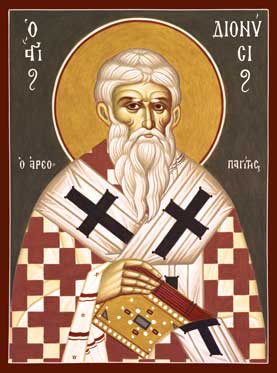
Hieromartyr, disciple of St. Paul (cf. Ac. 17:34), a witness of the repose of the Mother of God, & the second Bishop of Athens:
For, as I said elsewhere, the sacred instructors of our theological tradition call the “divine unions” the hidden & unrevealed sublimities of the super-unutterable & super-unknown isolation; but the “distinctions,” the goodly progressions & manifestations of the deity; &, following the sacred oracles, they mention also properties of the aforesaid union; & again of the distinction, that there are certain specific unions & distinctions. For example, with regard to the divine union, that is, the superessentiality, there is kindred & common to the one-springing Trinity, the superessential sustaining source, the super-divine deity, the super-good goodness, the supreme identity of the whole supreme idiosyncrasy, the oneness above source of one; the unspeakable; the much-speaking, the agnōsía, the comprehended by all, the placing of all, the abstraction of all, that which is above all affirmation & abstraction, the abiding & steadfastness in each other, if I may so speak, wholly super-united & in no part commingled of the one-springing Persons.
- On the Divine Names
St. Cyril of Jerusalem
| †5895 AM |
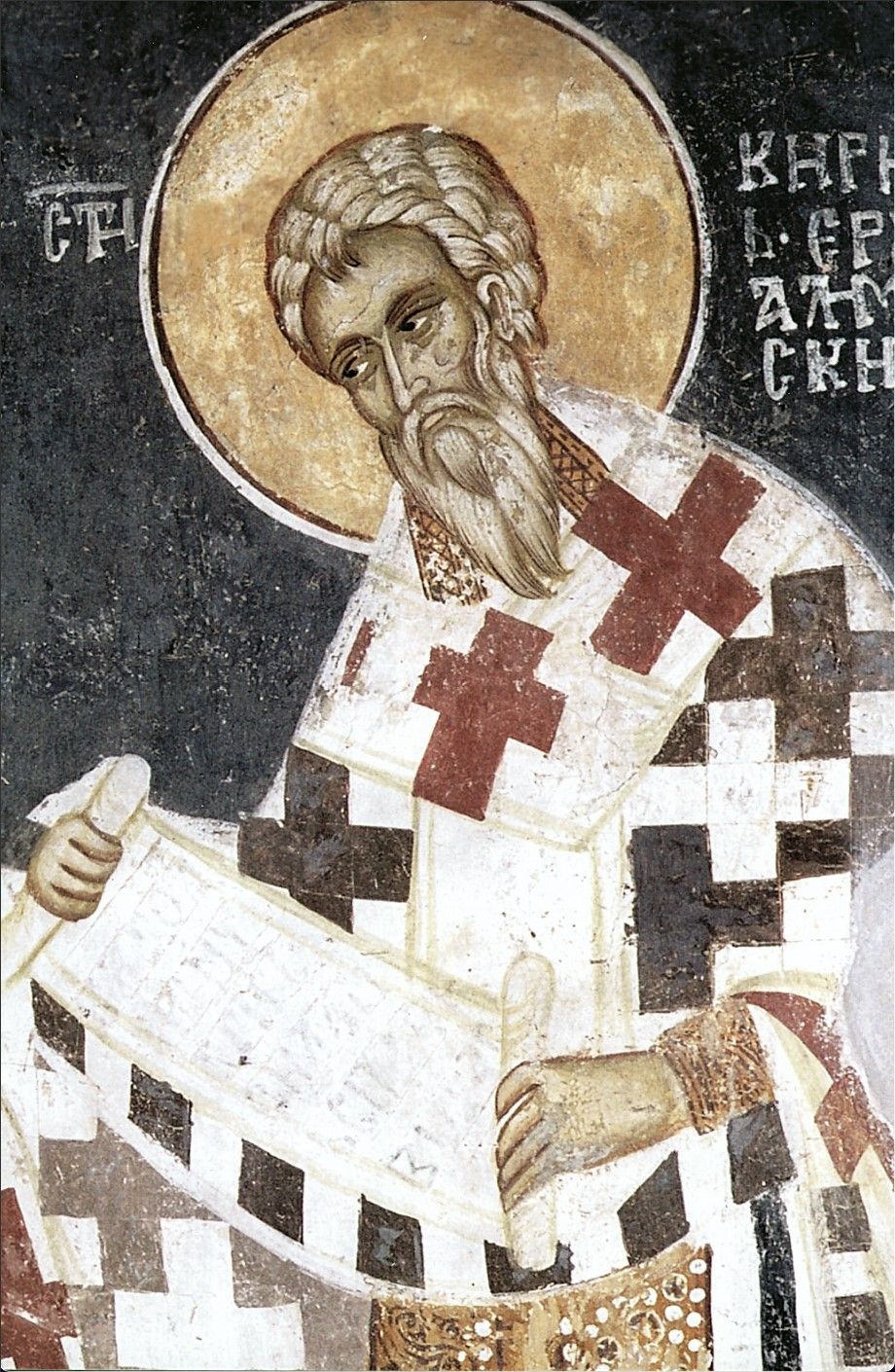
Participant at the Second Œcumenical Council, the Archbishop of Jerusalem, & author of the famous Catechetical Lectures:
The divine nature then it is impossible to see with eyes of flesh: but from the works, which are divine, it is possible to attain to some conception of His power, according to Solomon, who says, “For by the greatness & beauty of the creatures proportionably the Maker of them is seen.”
- Catechetical Lectures
Esaias too, with his majestic voice, says, “The Spirit of God shall rest upon Him, the spirit of wisdom & understanding, the spirit of counsel & might, the spirit of knowledge & godliness; & the spirit of the fear of God shall fill Him,” signifying that the Spirit is one & undivided, but His operations various.
- Catechetical Lectures
St. Basil the Great
| †5888 AM |
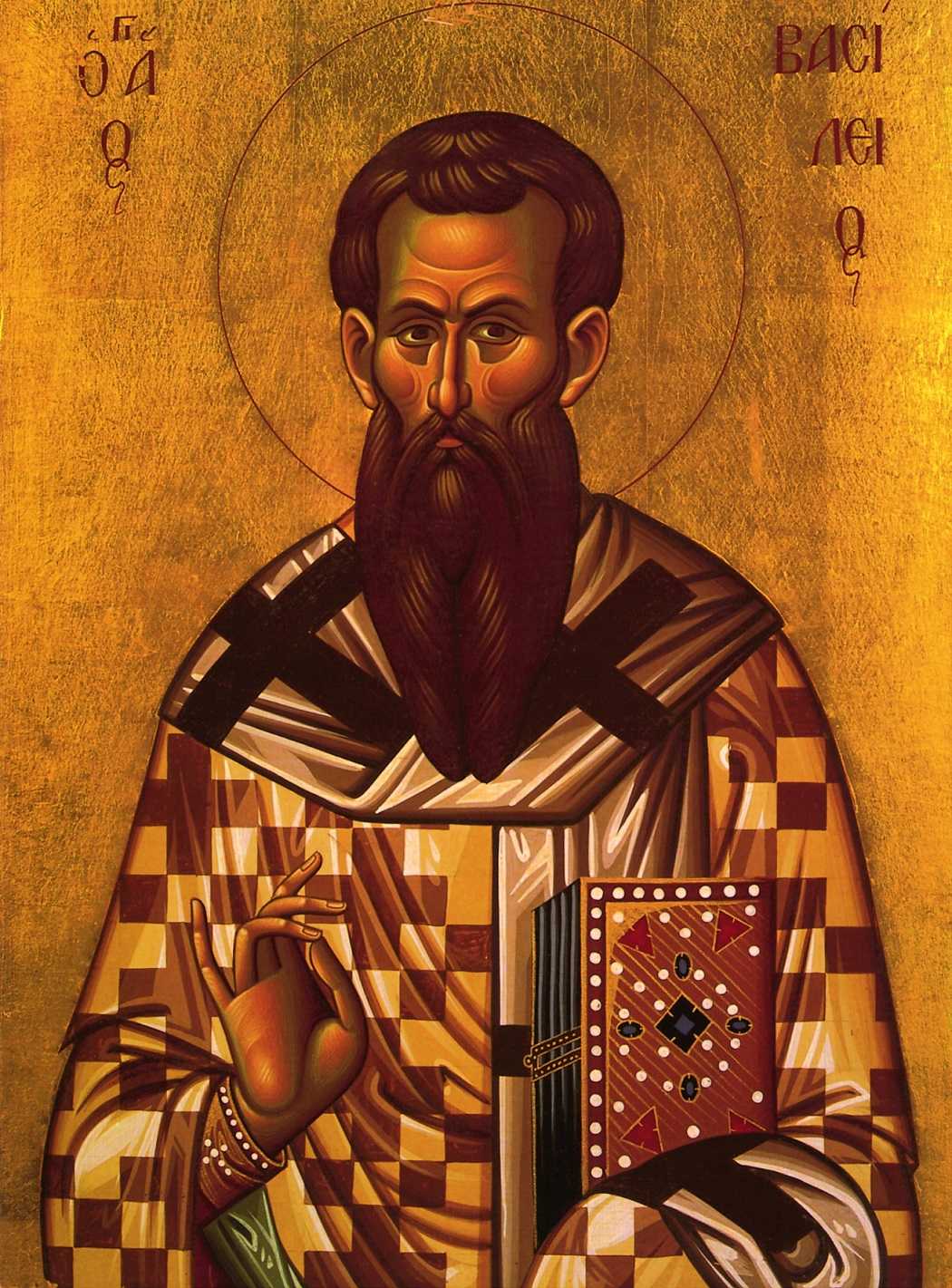
First of the Three Holy Hierarchs, the Archbishop of Cæsarea in Cappadocia, revealer of heavenly mysteries, renowned & bright star, glory & beauty of the Church, brother of SS. Gregory of Nyssa, Peter the Sebaste, & Macrina the Younger, son of St. Emily, & grandson of St. Macrina the Elder:
The divine nature, on the other hand, in all the words which are contrived, remains always inexplicable, as I always teach. We have learned that it is beneficent, judicial, righteous, good, & so on; & so have been taught differences of operations. But we are, nevertheless, unable to understand the nature of the Operator through our idea of the operations. Let anyone give an account of each one of these names, & of the actual nature to which they are applied, & it will be found that the definition will not in both cases be the same. Where the definition is not identical the nature is different. There is, then, a distinction to be observed between the essence, of which no explanatory term has yet been discovered, & the meaning of the names applied to it in reference to some operation or dignity. That there should be no difference in the operations we infer from the community of terms. But, we derive no clear proof of variation in nature, because, as has been said, identity of operations indicates community of nature. If then deity be the name of an operation, we say that the deity is one, as there is one operation of Father, Son, & Holy Spirit.
- Epistles
When all these high attributes have been enumerated, are they all names of one essence? But is there the same mutual force in His awfulness & His loving-kindness, His justice & His creative power, His providence & His foreknowledge, & His bestowal of rewards & punishments, His majesty & His providence? In mentioning any one of these do we declare His essence? … The operations are various, & the essence simple, but we say that we know our God from His operations, but do not undertake to approach near to His essence. His operations come down to us, but His essence remains beyond our reach.
- Epistles
St. Gregory of Nyssa
| †5893 AM |
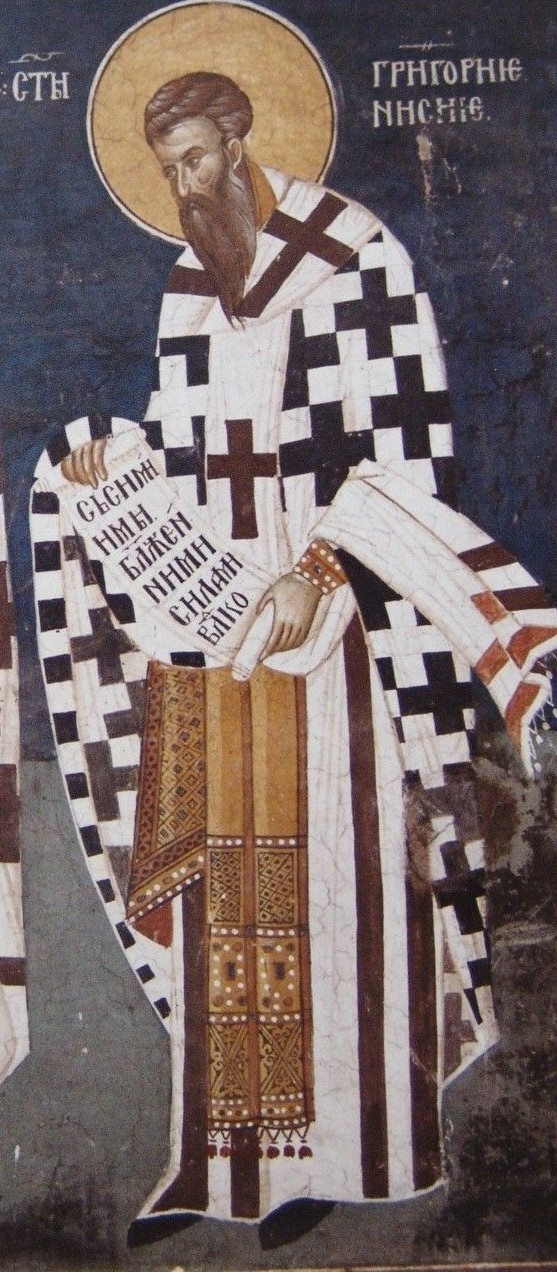
Father of Fathers, a participant at the Second Œcumenical Council, the Bishop of Nyssa in Cappadocia, & brother of St. Basil the Great:
What has been said displays after a fashion the truth of the Lord, Who promised the vision of God to the pure of heart. Nor, again, is Paul a liar when he displays in his own words that he has not seen God nor can see Him. For God Who is by nature beyond our sight is visible in His activities, being perceived in the characteristics that surround Him.
- On the Beatitudes
Similarly, says he, our Lord is in respect to Himself what He is essentially, but when named according to the differences of His operations, He has not one appellation in all cases, but takes a different name according to each notion produced in us from the operation.
- Answer to Eunomius’ Second Book
They say that divinity reveals the nature. But we know that the divine nature has no name which signifies it. But if something is said about it either by human convention or by the divine scriptures, it signifies something about that which surrounds divinity. But the divine nature itself remains unspoken & unuttered; it exceeds all possibility of being revealed by name. So the name divinity shows not the nature of the Spirit, but the power of seeing.
- On the Divinity of the Son & the Spirit
St. Cyril of Alexandria
| †5953 AM |
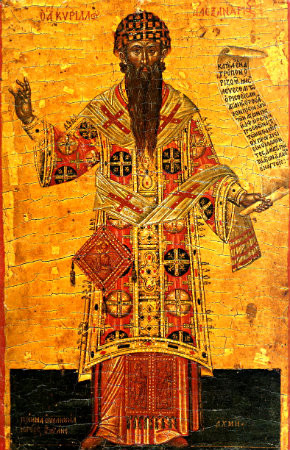
President at the Third Œcumenical Council & the Pope of Alexandria:
Creating belongs to the energy but begetting to the nature. Nature & energy are not identical.
- Thesaurus
If what belongs only to God is absolutely also His essence He will be composed for us out of many essences; for there are many things which belong only to Him by nature & to no other being. For He is King & Lord & Indestructible & Invisible &, in addition, innumerable other things which the divine scriptures say about Him. If, therefore, all things which are with Him lie in the order of essence, why, then, will the simple not be composed?
- Thesaurus
St. Sophronius of Jerusalem
| (†6153 AM) |
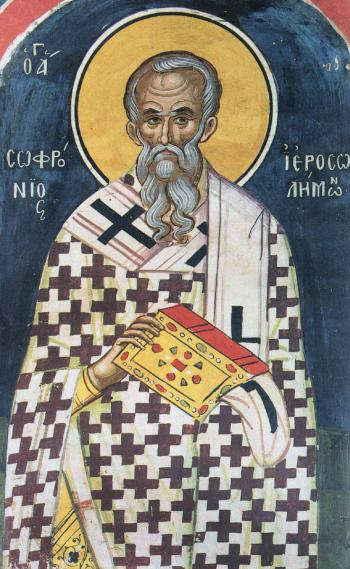
Patriarch of Jerusalem & author of the Life of St. Mary of Ægypt:
When the holy man [John the Forerunner] has done this, straightaway he sees the heavens open & the Spirit descending thence from the Father, not in Its own essence—for that is beyond the power of the eyes of man—but flying down in the form of a dove & lighting on Christ Himself, as being of like kind & kin & sharing the same divinity.
- Homily on the Baptism of Christ
St. Maximus the Confessor
| †6171 AM |
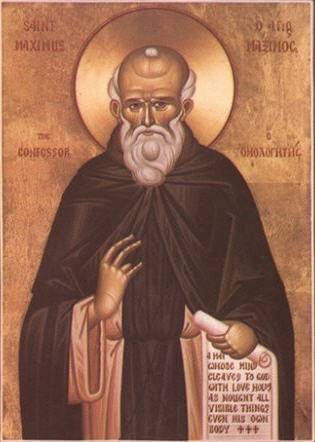
Vendicated by the Sixth Œcumenical Council & the disciple of St. Sophronius of Jerusalem:
Being led by the Truth to true religion, they might together with us readily confess that the word “unbegotten” signifies only that the Father is without origin—themselves seeing that, were they to persist in asserting their doctrine that the unbegotten is the essence of God, they would be completely forced to maintain that the incorporeal, & the unoriginate, & the immortal, & the immutable, & the incorruptible, are also by necessity the essence of God, along with whatever else we say that God is by means of privative negations on account of His transcendence. Being forced to be consistent with their own principles, they would be exposed & convicted for introducing many essences of God, & not one.
- Ambigua
Participable beings in which participant beings participate by grace, such as goodness & all that is included in the principle of goodness, are perhaps works of God which did not begin to be in time. Briefly, these include all life, immortality, simplicity, immutability & infinity, & all the other qualities that contemplative vision perceives as substantively appertaining to God. These are works of God, yet not begun in time. … God is infinitely above all beings, whether participant or participable. For whatever belongs to the category of being is a work of God, even though participant beings had a temporal origin, whereas participable beings were implanted by grace among things that come into existence in time. In this way participable beings are a kind of innate power clearly proclaiming God’s presence in all things.
- “Two Centuries on Theology” in: the Philocalia
But all the things that are around the essence do not disclose what the essence itself is, but what it is not, such as not being created, not having a beginning, not being finite, not being corporeal, & any other such things that are around the essence, & indicate what it is not, but not what it is. This is true even of the principles of providence & judgment, according to which the universe is wisely governed, & with which the harmonious contemplation of nature around God is said to take place, which shows only by analogy that its Creator exists. To be sure, negations stand in opposition to affirmations, becoming amicably interwoven with each other around God, each entering into & reciprocally complementing the other. Thus the negative statements indicate not that the Divine is something, but rather what It is not, & these are in compliance with the affirmations around That something (which the Divine is not). The affirmations, which indicate solely that the Divine exists, but not in anyway what It is, are united with the negations around That something (which the Divine is not). To the extent that the negations & affirmations are taken in relation to each other, they express opposition through antithesis, but when they are referred to God, they reveal their intimate relation by the manner in which the two extremes mutually condition each other.
- Ambigua
He who is deified through grace will be everything that God is, without possessing identity of essence.
- Ambigua
There is a single energy of God & the Saints … they are living icons of Christ, being the same as He is, by grace rather than by assimilation.
- Ambigua
St. John of Damascus
| †6289 AM |
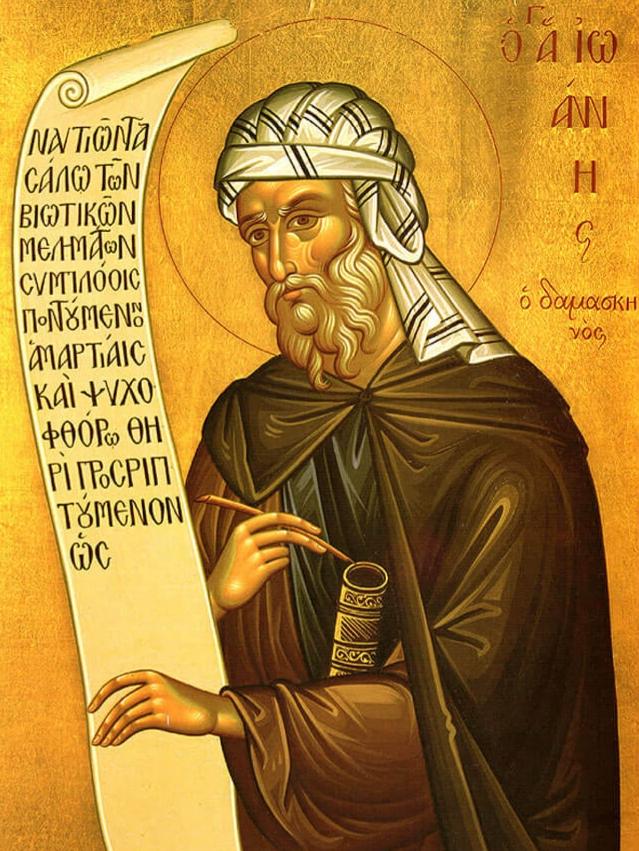
Chrysorroas, vendicated by the Seventh Œcuemnical Council, author of the Octoechos, & brother of St. Cosmo the Hymnographer:
All this, however, is by no means indicative of His essence—no more than is the fact of His being unbegotten, unoriginate, immutable, & incorruptible, or any of those other things which are affirmed of God or about Him. God, then, is limitless & incomprehensible, & then His limitlessness & incomprehensibility is all that can be understood about Him. All that we state affirmatively about God does not show His nature, but only what relates to His nature. And, if you should ever speak of good, or justice, or wisdom, or something else of the sort, you will not be describing the nature of God, but only things relating to His nature.
- “On the Orthodox Faith” in: the Fount of Knowledge
God is simple & uncompounded. But that which is composed of several different things is compounded. Consequently, should we say that the increate, unoriginate, incorporeal, immortal, eternal, good, creative, & the like are essential differences in God, then, since He is composed of so many things, He will not be simple but compounded, which is impious to the last degree. Therefore, one should not suppose that any one of these things which are affirmed of God is indicative of what He is in essence. Rather, they show either what He is not, or some relation to some one of those things that are contrasted with Him, or something of those things which are consequential to His nature or operation.
- “On the Orthodox Faith” in: the Fount of Knowledge
Now we also say that in our Lord Jesus Christ there are two operations. For, in so far as He was God & consubstantial with the Father, like the Father He had the divine operation; in so far as He was made man & consubstantial with us, He had the operation of the human nature. However, one must know that operation is one thing, what is operative is another, which is operated another, & still another the operator. Operation, then, is the efficacious & substantial motion of the nature. And that which is operative is the nature from which the operation proceeds. That which is operated is the effect of the operation. And the operator is the one who performs the operation; the person, that is.
- St. John of Damascus, “On the Orthodox Faith” in: the Fount of Knowledge
St. Gregory Palamas
| †6868 AM |
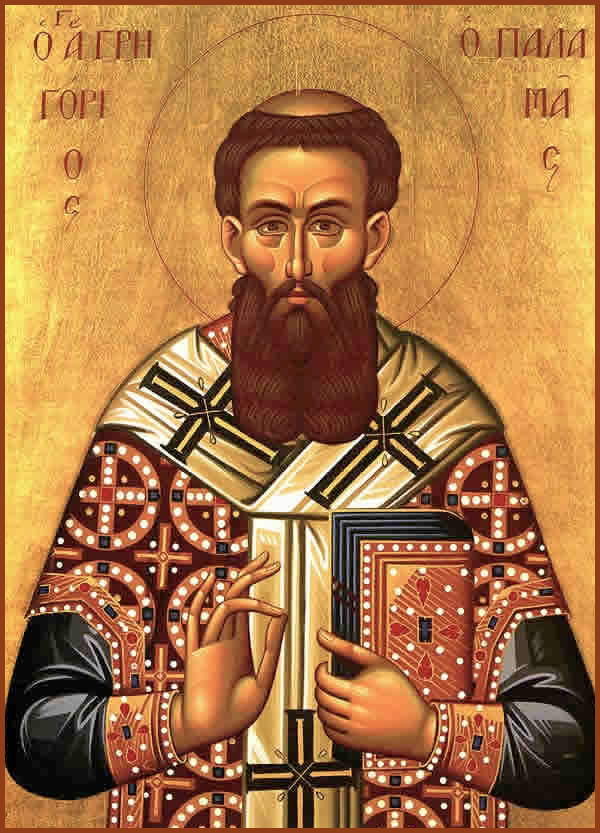
Second of the Pillars of Orthodoxy, vendicated by the Ninth Œcumenical Council, unerring teacher of the Church, & the Archbishop of Thessalonica:
Thus that which is created is not God’s energy—this is impossible—but what is effected & accomplished by the divine energy. This is why St. John of Damascus teaches that the energy, although distinct from the divine nature, is also an essential, that is to say, a natural activity of that nature. Since, then, it is the property of the divine energy to create, as St. Cyril has said, how could this energy be something created, unless it was activated by another energy, & that energy in turn by still another, & so on ad infinitum? In this way we would always be looking for the uncreated source of the energy.
- “Topics of Natural & Theological Science” in: the Philocalia
If the energies of God do not in any respect differ from the divine essence, then neither will they differ from one another. Therefore God’s will is in no way different from His foreknowledge, & consequently either God does not foreknow all things—because He does not will all that occurs—or else He wills evil also, since He foreknows all. This means either that He does not foreknow all things, which is the same as saying that He is not God, or that He is not good, which is also the same as saying that He is not God. Thus God’s foreknowledge does differ from His will, & so both differ from the divine essence. If the divine energies do not differ from one another, then God’s creative power is not distinct from His foreknowledge. But in that case, since God began to create at a particular moment, He also began to foreknow at abparticular moment. Yet if God did not have foreknowledge of all things before the ages how could He be God? If God’s creative energy does not differ in any respect from divine foreknowledge, then created things are concurrent with God’s foreknowledge. Thus because God unoriginately has foreknowledge & what is foreknown is unoriginately foreknown, it follows that God creates unoriginately, & therefore that created things will have been created unoriginately. But how shall He be God if His creatures are in no way subsequent to Him? If God’s creative energy in no respect differs from His fore knowledge, then the act of creating is not subject to His will, since His foreknowledge is not so subject. In that case God will create, not by an act of volition, but simply because it is His nature to create. But how will He be God if He creates without volition?
- “Topics of Natural & Theological Science” in: the Philocalia
One can find the term ’nature’ applied also to natural attributes, both in the case of created beings & in the case of God. Thus St. Gregory the Theologian says somewhere in his poems, “It is the nature of my King to bestow blessedness.” Now bestowing is not the nature of anything; it is, rather, the natural attribute of one who is beneficent. Similarly, with regard to fire one can say that its nature is to ascend upwards & to cast light upon those who behold it. Yet the motion in itself is not the nature of fire, nor is the production of light; rather its nature is the origin of the motion. Hence natural attributes are also called nature. This is confirmed by the great Dionysius when he says somewhere, “It is the nature of the Good to bring forth & to save,” meaning that these acts are attributes of the divine nature. Thus when you hear the fathers saying that God’s essence is imparticipable, you should see that they refer to the essence that does not depart from itself & is unmanifest. Again, when they say that it is participable, you should see that they refer to the procession, manifestation & energy that are God’s natural attributes.
- “Topics of Natural & Theological Science” in: the Philocalia
To refute both groups it is enough to show that not everything predicated of God is said with regard to His essence; it can be said relatively, that is, with relation to something that is not God’s essence. For example, the Father is spoken of in relation to the Son, for the Son is not the Father. God is called Lord in relation to the subject creation, for God is Lord over beings that are in time & in the eternal age, & also Lord over the ages themselves. But this dominion is an uncreated energy of God, distinct from His essence in that it is said in relation to something else, something which He Himself is not.
- “Topics of Natural & Theological Science” in: the Philocalia
But how does the energy, though it is seen to be in God, not introduce composition into God? Because only God possesses completely impassible energy: He alone acts without being acted upon. He does not come into existence, nor does He change.
- “Topics of Natural & Theological Science” in: the Philocalia
But to create & to energize can in the truest sense be predicated of God alone; for only God creates. He does not come into existence nor with respect to His essence is He acted upon. He alone through all things creates each one. He alone creates from absolute nothingness, since He possesses energy that is all-powerful. With respect to this energy He can be referred to in relation to creation & possesses potentiality. For He Himself in His own nature is not capable of being affected by anything at all, but if He wishes He is capable of adding to His creations. For God in His essence to be capable of being affected, of possessing or acquiring something, would denote weakness. But for God through His energy to be capable of creating, & of possessing & adding to His creations whenever He wishes, is a token of divinely fitting & almighty power.
- “Topics of Natural & Theological Science” in: the Philocalia
Those who assert that God is only essence, with nothing to be seen in Him, fabricate a God Who has neither creativity & energy nor relation. But if He Whom they suppose to be God does not possess these properties, then He is neither active nor Creator, nor does He possess an energy; & neither is He Principle, Creator & Master, nor is He our Father by grace. For how could He be these things if relation & creativity are not to be envisaged in His essence? Furthermore, if relation is not to be envisaged in God’s essence, the tri-hypostatic character of the Deity is also abolished. But He who is not tri-hyposlatic is not the Master of all or God. Thus those who hold the views of Barlaam & Acindynus are atheists.
- “Topics of Natural & Theological Science” in: the Philocalia
God also possesses that which is not essence. Yet because it is not essence it is not on that account an accident. For that which not only does not pass away but which also neither admits nor induces in itself the slightest increase or decrease, cannot be included among accidents. But the fact that it is neither an accident nor essence does not mean that it has no existence: it exists & it truly exists. It is not an accident, because it is altogether changeless. But again it is not an essence, because it is not among those things that are self-subsistent. … To speak in accord with all the theologians: if God creates by will & not simply because it is His nature to do so, then to will is one thing & natural being is another. If this is so, it means that God’s volition is other than the divine essence. Does it follow from this that because in God the will is other than the nature & is not an essence it therefore does not exist at all? Certainly not: it does exist & it pertains to God, who possesses not only essence but also a will with which He creates.
- “Topics of Natural & Theological Science” in: the Philocalia
According to the true faith of God’s Church which by His grace we hold, God possesses inherent energy that makes Him manifest & is in this respect distinct from His essence. For He foreknows & provides for inferior beings; He creates, sustains, rules & transforms them according to His own will & knowledge. In this way it is clear that He possesses an individual state of being, & that He is not simply essence lacking actual existence. But since all these energies are to be seen not in one but in three Persons, God is known to us as one essence existing in three individual states of being or Hypostases. But the followers of Acindynus, by asserting that God does not have inherent energy that makes Him manifest & is in this respect distinct from His essence, are saying that God does not possess an individual state of being, & they entirely deprive the tri-hypostatic Lord of actual existence.
- “Topics of Natural & Theological Science” in: the Philocalia