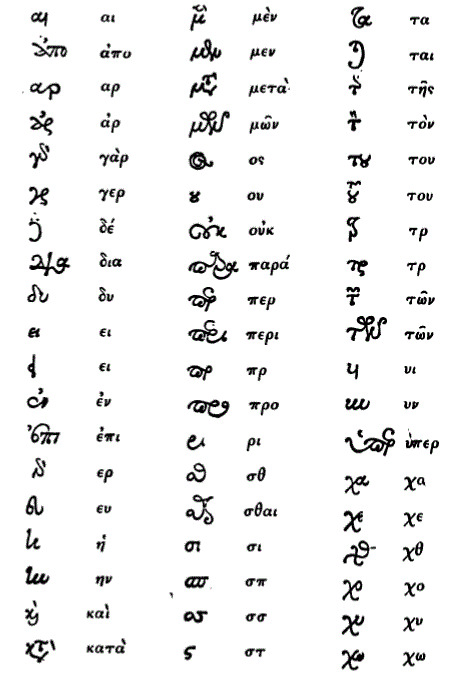
The letters ε & υ were in prior times called εἶ &
ὑ. The word simple (psilón) was appended to their
names to distinguish them from the complex sounds αι &
οι.
The letters ο & ω were previously called οὖ & ὦ.
The words lesser (micrón) & greater (méga) were
appended to their names to distinguish them from each
other.
The letter σ was also called sán.
It should be known that the use of the macron (◌̄)
above e & o for η & ω is a not an ancient but
rather contemporary practice.
There are three additional letters only used now as
numerals:
Greek
Latin
ϛ
ἐπίσημον
epísēmon
ϟ
κόππα
cóppa
ϡ
σαμπί
sampí
Further, the following digraphs are translated thus:
Greek
Latin
αι
æ
αυ
au
γγ
ng
γκ
nc
γξ
nx
γχ
nch
ει
ī
ευ
eu
ηυ
ēu
οι
œ
ου
u
υι
ui
ωυ
ōu
When translating names from Greek to Latin, -os is
translated as -us, -ia as -y, -ion as -ium,
-ros as -er, & -ōn as -o.
When translating certain sounds to Greek which it
naturally doesn’t have, put τζ for gi, & τσ or σχ
for ci.
Ligatures
Ligature
Meaning
ϗ
καί
ȣ
ου
ϛ
στ
More which have not digital characters yet:
Pronunciation
Letter
Sound
α
a
αυ
av, af
β
v
γ
g
γγ
g, ng
γκ
c, ngc
γξ
cs, ngcs
γχ
h, ngh
δ
ð
ε αι
e
ευ
ev, ef
ζ
z
η ι ει οι υ υι
i
θ
th
κ
c
λ
l
μ
m
μπ
b, mb
ν
n
ντ
d, nd
ξ
cs
ο ω
o
ου
u
π
p
ρ
r
σ ς
s
τ
t
τζ
dz
φ
f
χ
h
ψ
ps
The letters αυ & ευ are pronounced af & ef before a
mute—e.g θ, τ—but áv & ev before a semivowel or
vowel—e.g. β, α.
Phonœcian & Latin
Phonœcian
Capital
Unicial
Latin
𐤀
Α
α
A
𐤁
Β
β
B
𐤂
Γ
γ
C G
𐤃
Δ
δ
D
𐤄
Ε
ε
E
𐤅
Ϝ Y
ϛ υ
F V Y
𐤆
Ζ
ζ
Z
𐤇
Η
η
H
𐤈
Θ
θ
𐤉
Ι
ι
I
𐤊
Κ
κ
K
𐤋
Λ
λ
L
𐤌
Μ
μ
M
𐤍
Ν
ν
N
𐤎
Ξ
ξ
X
𐤏
Ο Ω
ο ω
O
𐤐
Π
π
P
𐤑
ͳ
ϡ
𐤒
Ϙ
ϟ
Q
𐤓
Ρ
ρ
R
𐤔
Σ
σ ς
S
𐤕
Τ
τ
T
Φ
φ
Χ
χ
Ψ
ψ
Ægyptian
Letters
The Ægyptians (i.e. Copts) adopted Greek letters for
writing, but added seven letters: